What is XIV in Roman Numerals? Complete Guide + Examples
Quick Answer
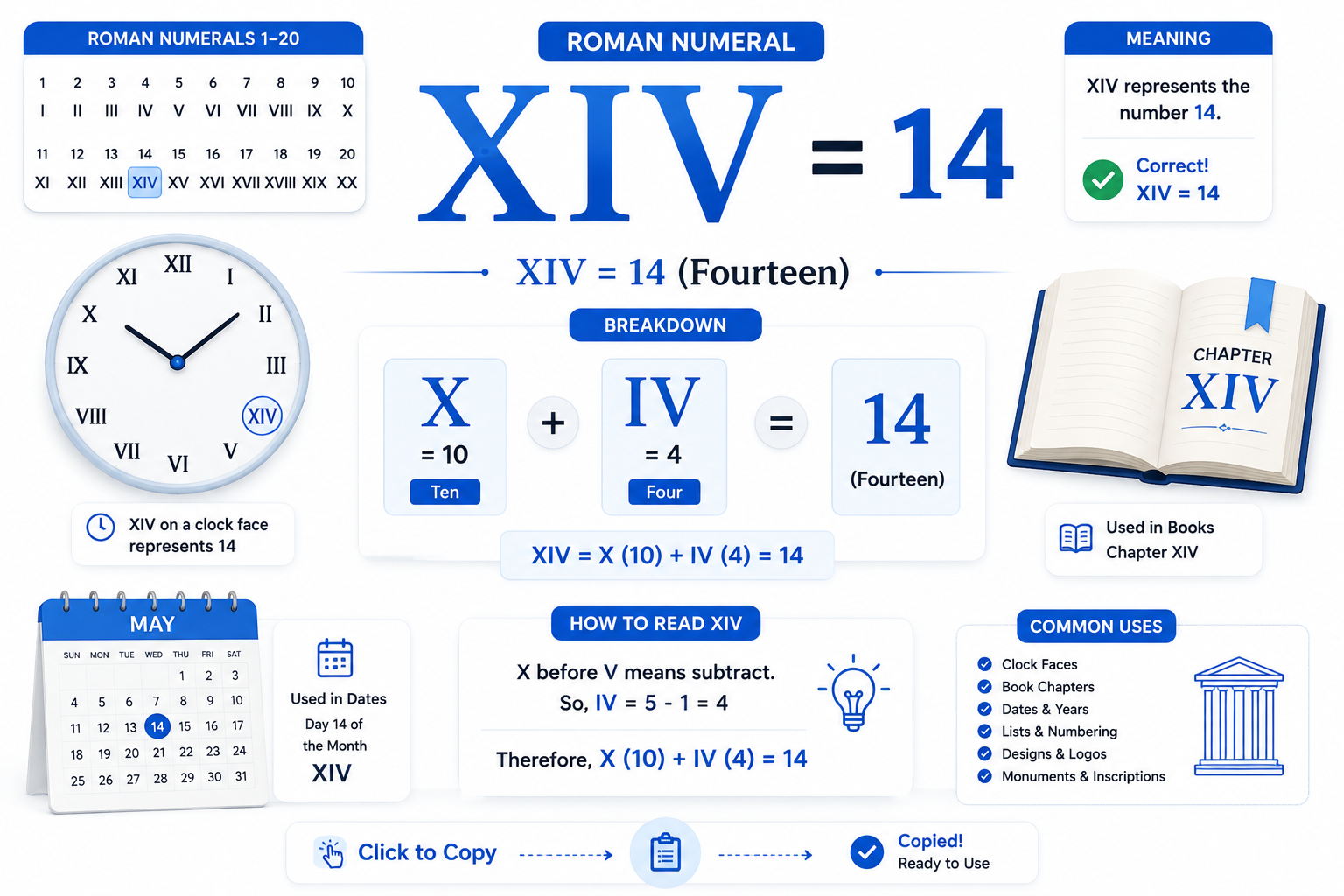
XIV in Roman numerals means 14. It’s written by combining X (10) and IV (4), which together equal 14. If you need to copy XIV, use our copy-paste tool at the top of this page for instant access.
What Does XIV Mean?
XIV is a Roman numeral that represents the number 14 in our modern decimal system. Understanding what XIV means is straightforward once you break down its component symbols.
The Roman numeral XIV is composed of:
- X = 10
- IV = 4 (which is 5 – 1 using the subtractive principle)
When you add these together: 10 + 4 = 14
So XIV = 14. This is the fundamental meaning of this Roman numeral.
Breaking Down XIV Step by Step
Understanding the Symbols
X (the first symbol) represents 10. It’s one of the most common Roman numerals and appears in many numbers from 10 to 99.
IV (the second symbol) represents 4. This uses the subtractive principle of Roman numerals, where a smaller symbol before a larger one is subtracted. In this case, I (1) before V (5) means 5 – 1 = 4.
The Math
XIV = X + IV
XIV = 10 + 4
XIV = 14
This simple addition is how you understand any Roman numeral. Each symbol has a value, and when combined (either additively or subtractively), they create the total number.
How to Read XIV
When you encounter XIV in text, you read it aloud as “fourteen”. You don’t spell out X-I-V; instead, you recognize the numeral and speak its numerical value.
Examples in context:
- “This is Chapter XIV” = “This is Chapter fourteen”
- “Founded in year XIV” = “Founded in year fourteen”
- “Page XIV” = “Page fourteen”
Your brain should automatically translate XIV to its numerical value of 14, just as you would with the Arabic numeral “14”.
XIV vs Other Numerals Around It
To understand XIV better, let’s see how it compares to nearby numerals:
XII = 12 (X + II = 10 + 2)
XIII = 13 (X + III = 10 + 3)
XIV = 14 (X + IV = 10 + 4) ← This is XIV
XV = 15 (X + V = 10 + 5)
XVI = 16 (X + VI = 10 + 6)
Notice the pattern: all numbers from 10-19 start with X (10) and then add the ones place value (I through IX). XIV follows this predictable pattern perfectly.
Common Uses of XIV
Book Chapters
Many traditional books, especially older publications and academic texts, use Roman numerals for their introductory chapters and preliminary material. You might see:
- Preface (Roman numerals: i, ii, iii, iv, v…)
- Main Content (Arabic numerals: 1, 2, 3, 4, 5…)
- Appendices (Sometimes letters: A, B, C…)
If you’re reading a classic novel or academic book and encounter “Chapter XIV”, it means Chapter 14.
Formal Documents
Legal documents, court filings, and official government records sometimes use Roman numerals. You might see:
- Section XIV = Section 14
- Paragraph XIV = Paragraph 14
- Item XIV = Item 14
Historical Dates
Historical references often use Roman numerals for years. While less common now, you might encounter dates written as:
- Year XIV of the king’s reign
- Established in year [Roman numeral]
Clock Faces
On traditional analog clocks and watches, Roman numerals often appear around the face. The position opposite to XII (12) at the top would be VI (6) at the bottom. Numbers are distributed around the clock face, and XIV might appear on a 24-hour clock or historical timepiece.
Personal Tattoos
Roman numerals are popular for tattoos representing important dates. Someone might get XIV tattooed to represent:
- Birth date: 14 (XIV) of a month
- Anniversary date: a special date marked as XIV
- Meaningful number: the numeral 14 for personal significance
Movie Credits
Films sometimes use Roman numerals in copyright notices and opening credits:
- © MMXXVI (Copyright 2026)
Writing 14 in Roman Numerals
If you need to write the number 14 in Roman numerals, the only correct way is XIV. There is no alternative standard form.
You should never write:
- XIIII (This violates the rule against repeating symbols more than three times)
- VIV (This is incorrect; V cannot be repeated)
- IIX (This is incorrect; only X can be subtracted from L or C)
XIV is the one correct way to represent 14 in Roman numerals.
The Subtractive Principle Explained
XIV demonstrates the subtractive principle in action. Here’s how it works:
In the IV portion:
- I comes before V
- I = 1, V = 5
- When a smaller value appears before a larger value, you subtract: 5 – 1 = 4
- Therefore, IV = 4
This subtractive principle is essential to understanding Roman numerals. Without it, there would be no way to represent 4, 9, 40, 90, 400, or 900 efficiently.
Rules for the subtractive principle:
- Only I can be subtracted from V and X
- Only X can be subtracted from L and C
- Only C can be subtracted from D and M
- You never subtract V, L, or D
- You never use more than one subtractive pair in a row
XIV follows these rules correctly, with IV being a valid subtractive pair.
Easy Way to Remember XIV
Memory tip: Think of XIV as “X plus IV” or “10 plus 4”.
- X is easy to remember as 10 (like the X symbol looks like a cross, representing the fingers of both hands: 5 + 5)
- IV is the Roman numeral for 4 (one less than V, which is 5)
- Add them together: 10 + 4 = 14
Once you understand this basic pattern, you can apply it to other numbers. All numbers in the tens use this same structure: a base X (10) plus the ones digit.
How to Copy XIV
If you need to use the Roman numeral XIV in your documents, use our copy-paste tool above:
- Click the symbol XIV
- Click “Copy” to copy it to your clipboard
- Paste it (Ctrl+V or Cmd+V) in your document
- The numeral appears instantly
This works on all devices and doesn’t require any special software.
FAQ About XIV
Q: Is XIV always 14? A: Yes, XIV always represents 14. This is standardized across all uses of Roman numerals.
Q: Can you write 14 any other way in Roman numerals? A: No, XIV is the only correct way to write 14. There are no accepted variations.
Q: Why not just use 14 instead of XIV? A: Roman numerals are used for tradition, historical accuracy, aesthetics, and formal contexts. They add elegance to documents and are understood globally as a historical system.
Q: Where will I actually see XIV? A: You’ll see it in book chapters, formal documents, clock faces, historical references, movie credits, and increasingly in tattoos and jewelry.
Q: How do I pronounce XIV in different languages? A: In English, it’s “fourteen”. The pronunciation is always based on the number’s value (14), not on the letters themselves, regardless of the language.
Q: Is XIV difficult to learn? A: No, XIV is one of the easier Roman numerals to understand because it simply combines X (10) and IV (4). Once you learn a few basic symbols and the additive/subtractive principles, XIV becomes obvious.
Related Roman Numerals to Know
Learning XIV helps you understand nearby numerals:
10 = X
11 = XI (X + I)
12 = XII (X + II)
13 = XIII (X + III)
14 = XIV (X + IV) ← You are here
15 = XV (X + V)
16 = XVI (X + VI)
17 = XVII (X + VII)
18 = XVIII (X + VIII)
19 = XIX (X + IX)
20 = XX (X + X)
If you can read XIV, you can read all of these using the same logic.
Conclusion
XIV is a simple Roman numeral representing 14. It combines X (10) and IV (4) to create a value of 14. Whether you encounter it in book chapters, formal documents, clock faces, or historical references, understanding that XIV = 14 is all you need.
Now that you know what XIV means and how it works, you understand one of the fundamental building blocks of the Roman numeral system. The same principles that explain XIV apply to dozens of other Roman numerals, making the entire system easier to master.
Use our copy-paste tool above whenever you need to insert XIV into your documents, emails, or other applications. No special keyboard knowledge required!