How to Memorize Greek Alphabet: Complete Learning Guide + Order, Song & Tips
Memorizing the 24 letters of the Greek alphabet can seem overwhelming at first, but with the right strategies, proven mnemonics, and consistent practice, anyone can master it in just a few days. Whether you’re a student preparing for exams, a professional entering a field that uses Greek symbols, or simply curious about expanding your knowledge, this comprehensive guide provides multiple proven methods to memorize the Greek alphabet quickly and retain it permanently.
The Greek alphabet is fundamental to mathematics, physics, chemistry, statistics, engineering, and countless academic fields. By learning to recognize and recall all 24 letters in order, you’ll gain a significant advantage in your studies and professional pursuits. This guide combines traditional memory techniques, musical learning, visual mnemonics, and interactive practice to help you master the Greek alphabet efficiently.
Let’s explore the fastest, most effective methods to memorize all 24 Greek letters today!
Section 1: The Complete Greek Alphabet in Order
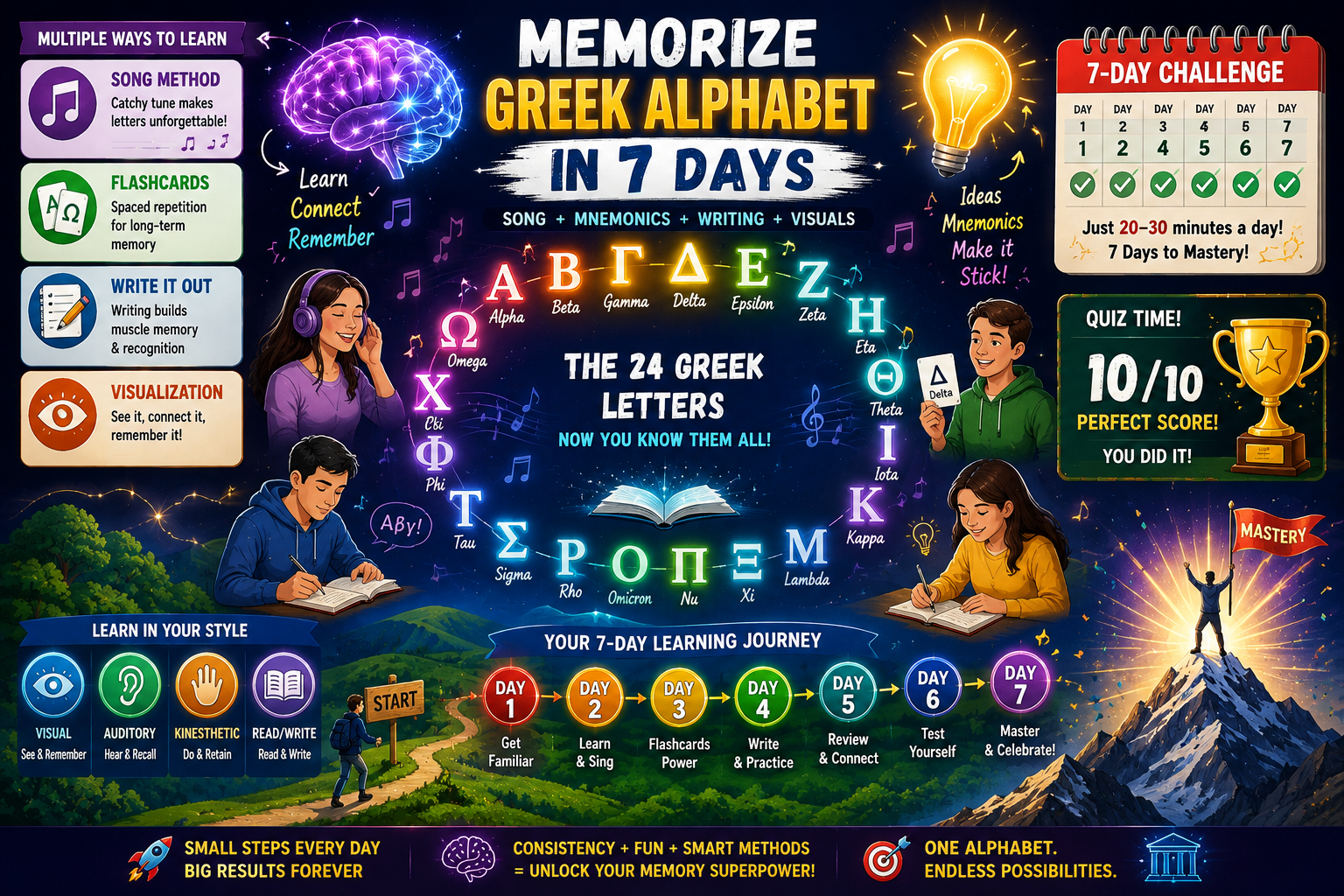
All 24 Letters (Master This!)
Understanding the correct order is the first step to memorization:
1. Α – Alpha
2. Β – Beta
3. Γ – Gamma
4. Δ – Delta
5. Ε – Epsilon
6. Ζ – Zeta
7. Η – Eta
8. Θ – Theta
9. Ι – Iota
10. Κ – Kappa
11. Λ – Lambda
12. Μ – Mu
13. Ν – Nu
14. Ξ – Xi
15. Ο – Omicron
16. Π – Pi
17. Ρ – Rho
18. Σ – Sigma
19. Τ – Tau
20. Υ – Upsilon
21. Φ – Phi
22. Χ – Chi
23. Ψ – Psi
24. Ω – Omega
Breaking Into Groups
Don’t try to memorize all 24 at once. Break them into manageable groups of 6:
Group 1 (Letters 1-6): Alpha, Beta, Gamma, Delta, Epsilon, Zeta
Group 2 (Letters 7-12): Eta, Theta, Iota, Kappa, Lambda, Mu
Group 3 (Letters 13-18): Nu, Xi, Omicron, Pi, Rho, Sigma
Group 4 (Letters 19-24): Tau, Upsilon, Phi, Chi, Psi, Omega
Master one group per day, and you’ll know the entire alphabet in 4 days!
Section 2: Method 1 – The Greek Alphabet Song (Easiest!)
Why Songs Work
Music is one of the most powerful memory tools. Your brain remembers melodies much faster than plain text. The Greek alphabet song works because:
- Rhythm creates automatic recall
- Melody makes repetition enjoyable
- Rhyme patterns reinforce memory
- Singing activates multiple brain regions
- It’s fun and less tedious than rote memorization
The Traditional Greek Alphabet Song
Sing this to the tune of the “ABCs” (same melody as English alphabet song):
Alpha, Beta, Gamma, Delta,
Epsilon, Zeta, Eta, Theta!
Iota, Kappa, Lambda, Mu,
Nu and Xi, Omicron too!
Pi and Rho and Sigma,
Tau and Upsilon, Phi!
Chi, Psi, Omega—
That’s the Greek alphabet, bye!
How to Use This Song
- Listen: Hear the melody first (search “Greek alphabet song” on YouTube)
- Sing Along: Sing with the video multiple times
- Sing Alone: Once familiar, sing without the video
- Practice Daily: Sing it 3-4 times daily for 3 days
- Result: You’ll remember all 24 letters perfectly
Alternative Melody
If you prefer a different tune, sing it to:
- “Twinkle, Twinkle, Little Star”
- “Mary Had a Little Lamb”
- “Happy Birthday”
- Any familiar melody with 24+ syllables
The melody matters less than consistent repetition. Pick one you enjoy and stick with it!
Section 3: Method 2 – Mnemonic Devices (Memory Tricks)
What Are Mnemonics?
Mnemonics are memory aids that connect new information to something you already know. They’re incredibly effective for memorizing sequences.
The First 12 Letters Mnemonic
“All Big Greek Dudes Enjoy Zipping Huge Tents In Kansas, Lol, Man!”
Breaking it down:
- All = Alpha
- Big = Beta
- Greek = Gamma
- Dudes = Delta
- Enjoy = Epsilon
- Zipping = Zeta
- Huge = Heta
- Tents = Theta
- In = Iota
- Kansas = Kappa
- Lol = Lambda
- Man = Mu
The Last 12 Letters Mnemonic
“Never X-ray Oranges, Please! Really Serious Trouble Unless Young People Find Chi Psi Omega”
Breaking it down:
- Never = Nu
- X-ray = Xi
- Oranges = Omicron
- Please = Pi
- Really = Rho
- Serious = Sigma
- Trouble = Tau
- Unless = Upsilon
- Young = Y (Phi sounds like “fee”)
- People = Phi
- Find = (Chi sounds like “key”)
- Chi = Chi
- Psi = Psi
- Omega = Omega
Create Your Own Mnemonics
The best mnemonics are ones YOU create because personal connection = better memory! Make sentences using:
- Your friends’ names
- Things you love
- Funny or absurd images
- Personal experiences
The weirder and more personal, the better you’ll remember!
Section 4: Method 3 – Visual Learning (See & Remember)
Associating Letters with Images
Your brain remembers images 65,000x better than words! Create mental images for each letter:
Alpha (Α): Looks like an “A” with a pointed roof → Imagine an Apple orchard
Beta (Β): Looks like a “B” → Imagine a Banana
Gamma (Γ): Looks like an upside-down “L” → Imagine a Gun
Delta (Δ): Looks like a triangle → Imagine a Delta river (triangular)
Epsilon (Ε): Looks like “E” → Imagine an Elephant
Zeta (Ζ): Looks like a “Z” → Imagine a Zebra
Theta (Θ): Looks like a circle with line → Imagine Θinking (brain)
Lambda (Λ): Looks like an upside-down “V” → Imagine Lightning bolt
Pi (Π): Looks like a gate → Imagine Pie (goes through the gate)
Sigma (Σ): Looks like a snake → Imagine a Snake
Omega (Ω): Looks like a horseshoe → Imagine the Ωnd (end)
Flash Card Method
- Create physical or digital flashcards
- Front: Greek letter symbol
- Back: Name + your personal image
- Study 10 minutes daily
- Review harder cards more frequently
Memory Palace Technique
Imagine walking through a familiar place (your home, school, favorite store) and place each Greek letter at different locations:
- Front Door: Alpha (Α)
- Living Room: Beta (Β)
- Kitchen: Gamma (Γ)
- Bedroom: Delta (Δ)
- Bathroom: Epsilon (Ε)
- Continue through your space…
When you mentally walk through this “palace,” you’ll recall letters in perfect order!
Section 5: Method 4 – Writing & Repetition
The Importance of Handwriting
Writing engages more brain regions than reading or typing. Studies show handwriting increases memory retention by 65%.
Daily Writing Practice (5 Minutes)
Day 1: Write Group 1 (Alpha-Zeta) 10 times each
Day 2: Write Group 2 (Eta-Mu) 10 times each
Day 3: Write Group 3 (Nu-Sigma) 10 times each
Day 4: Write Group 4 (Tau-Omega) 10 times each
Day 5: Write all 24 letters 5 times in order
Effective Writing Strategy
- Write the SYMBOL: Α, Β, Γ, Δ…
- Write the NAME: Alpha, Beta, Gamma, Delta…
- Say it OUT LOUD: Hearing yourself reinforces memory
- Use different colors: Different colored pens for each group
- Write with PURPOSE: Not mindlessly, but carefully and intentionally
Section 6: Method 5 – Understanding Through Math & Science
Learn Letters Through Their USES
When you understand WHY a letter matters, you remember it better!
Alpha (Α): First angle in geometry → Remember “A is for Angle”
Beta (Β): Second angle → Remember “B is second letter, so 2nd angle”
Gamma (Γ): Third angle/Greek letter → Remember “G is 3rd angle”
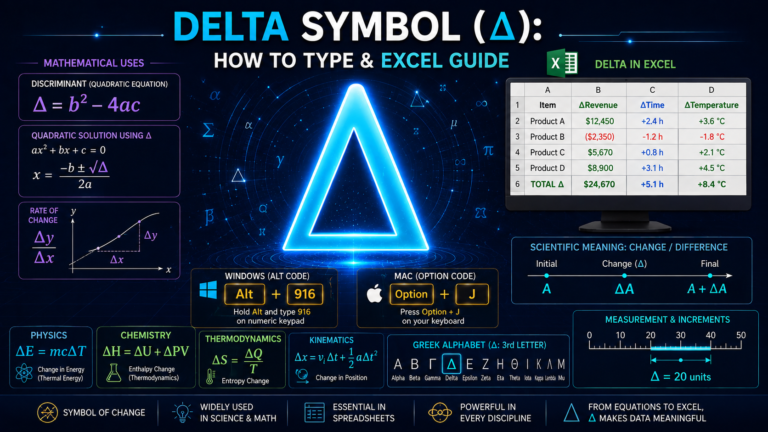
Delta (Δ): CHANGE in mathematics → Remember “D is for Difference”
Theta (Θ): Most common angle symbol → Remember “Popular angle”
Lambda (Λ): Wavelength in physics → Remember “L is for Light waves”
Pi (Π): Circle constant (3.14159…) → Remember “P is for Pi = circles”
Sigma (Σ): SUM symbol → Remember “S is for Sum”
Phi (Φ): Golden ratio (1.618…) → Remember “P is for Perfect ratio”
Omega (Ω): Electrical resistance (Ohms) → Remember “Last letter = final measurement”
Learn Through Real Applications
- In a math class: When you learn trigonometry, you’ll encounter θ constantly
- In physics: λ (wavelength) appears in wave equations
- In statistics: σ (sigma) is standard deviation
- In engineering: Ω (omega) is ohms (electrical resistance)
Context-based learning is 8x more effective than memorization alone!
Section 7: Complete Greek Alphabet with Pronunciation
Pronunciation Guide (British English)
1. Α – Alpha (AL-fuh) – “A” sound at start
2. Β – Beta (BAY-tuh) – “B” sound at start
3. Γ – Gamma (GAM-uh) – Hard “G” sound
4. Δ – Delta (DEL-tuh) – “D” sound at start
5. Ε – Epsilon (EP-si-lon) – “E” as in “set”
6. Ζ – Zeta (ZAY-tuh) – “Z” sound at start
7. Η – Eta (AY-tuh) – Long “A” sound
8. Θ – Theta (THAY-tuh) – “TH” sound as in “thin”
9. Ι – Iota (eye-OH-tuh) – Starts with “eye” sound
10. Κ – Kappa (KAP-uh) – Hard “K” sound
11. Λ – Lambda (LAM-duh) – “L” sound at start
12. Μ – Mu (MYOO) – “M” sound, rhymes with “blue”
13. Ν – Nu (NOO) – “N” sound, rhymes with “blue”
14. Ξ – Xi (ZY) – Can sound like “Z” + “Y”
15. Ο – Omicron (OM-i-kron) – “O” as in “on”
16. Π – Pi (PY) – “P” + “eye”
17. Ρ – Rho (ROH) – “R” + “o” sound
18. Σ – Sigma (SIG-muh) – “S” sound at start
19. Τ – Tau (TAW) – “T” + “aw” sound
20. Υ – Upsilon (OOP-si-lon) – “OOP” + “si”
21. Φ – Phi (FY) – “F” + “eye”
22. Χ – Chi (KY) – Hard “K” + “eye”
23. Ψ – Psi (PSY) – “P” + “sy”
24. Ω – Omega (OH-may-guh) – “O” + “may” + “guh”
Pronunciation Practice (5 Minutes Daily)
Say each letter OUT LOUD 3 times:
- Listen to your own voice
- Correct pronunciation if needed
- Feel the mouth movements
- Repeat daily for fluency
Section 8: 7-Day Memorization Challenge
Day 1: Introduction + Groups 1-2
- Morning: Watch Greek alphabet song video (5 min)
- Afternoon: Learn Groups 1-6 with mnemonics (15 min)
- Evening: Write Groups 1-6 five times (10 min)
- Total Time: 30 minutes
- Result: First 6 letters memorized
Day 2: Groups 2 Complete
- Morning: Sing Greek alphabet song (5 min)
- Afternoon: Learn Groups 7-12 with visuals (15 min)
- Evening: Write Groups 7-12 five times (10 min)
- Total Time: 30 minutes
- Result: First 12 letters memorized
Day 3: Groups 3 Complete
- Morning: Sing Greek alphabet song (5 min)
- Afternoon: Learn Groups 13-18 (15 min)
- Evening: Write Groups 13-18 five times (10 min)
- Total Time: 30 minutes
- Result: First 18 letters memorized
Day 4: Complete Alphabet
- Morning: Sing Greek alphabet song (5 min)
- Afternoon: Learn Groups 19-24 (15 min)
- Evening: Write all 24 letters three times (15 min)
- Total Time: 35 minutes
- Result: All 24 letters memorized!
Day 5-7: Reinforcement
- Daily: Sing song (5 min) + Write all 24 (10 min) + Flashcards (10 min)
- Total: 25 minutes daily
- Result: Perfect recall established
Total Investment: Less than 2 hours over 7 days = Permanent memorization!
Section 9: Interactive Quiz – Test Your Knowledge
Quick Recall Quiz
Can you answer these without looking up?
- What is the 4th letter of the Greek alphabet?
- How many letters total are in the Greek alphabet?
- What does the symbol Δ represent in math?
- What is the last letter of the Greek alphabet?
- Which letter represents the mathematical constant 3.14159?
- In what order does Theta appear?
- What is the symbol for sum in mathematics?
- How do you pronounce Xi?
- Which letter is the golden ratio associated with?
- What does Omega represent in electrical engineering?
Answers:
- Delta (Δ)
- 24 letters
- Change or difference
- Omega (Ω)
- Pi (Π)
- 8th letter
- Sigma (Σ)
- “ZY” or “KSEE”
- Phi (Φ)
- Ohms (electrical resistance)
Scoring: 10/10 = Perfect! 8-9/10 = Excellent! 6-7/10 = Good, review weak areas
Section 10: Common Mistakes to Avoid
Mistake 1: Skipping the Order
Wrong: Memorizing random letters
Right: Always learn in order (1-24). Order is the framework everything else attaches to.
Mistake 2: Only Reading
Wrong: Just reading the names repeatedly
Right: Speak, write, sing, visualize. Use all senses.
Mistake 3: Going Too Fast
Wrong: Trying to memorize all 24 in one day
Right: Learn 6 per day for 4 days. Quality over speed.
Mistake 4: No Repetition
Wrong: Learning once and expecting retention
Right: Spaced repetition (Day 1, Day 2, Day 3, then weekly review)
Mistake 5: Disconnected from Purpose
Wrong: Memorizing just for memorization
Right: Learn why each letter matters (math, science, etc.)
Mistake 6: Pronunciation Neglect
Wrong: Memorizing symbols but not knowing how to say them
Right: Practice pronunciation daily alongside symbol recognition
Section 11: Tips for Different Learning Styles
For Visual Learners
- Use colors: Different color for each group
- Create flashcards: With images and symbols
- Draw mnemonics: Illustrate your memory tricks
- Watch videos: Greek alphabet song and pronunciation videos
- Use mind maps: Show connections between letters
For Auditory Learners
- Sing the song: Multiple times daily
- Speak out loud: Say each letter and name
- Listen to podcasts: Greek language learning podcasts
- Verbal mnemonics: Create rhyming phrases
- Record yourself: Listen to your own voice
For Kinesthetic Learners
- Write constantly: Multiple times daily
- Trace letters: With finger in air or on paper
- Use physical flashcards: Handle them during practice
- Walk through memory palace: Physically move while recalling
- Dance to the song: Add movement with melody
For Reading/Writing Learners
- Read pronunciation: Multiple times daily
- Write each letter: With proper spelling
- Create documents: Greek alphabet guides
- Read stories: That incorporate Greek letters
- Take notes: While learning each letter
Section 12: Maintenance & Long-Term Retention
After You’ve Memorized (First Week)
Weeks 2-4: Review 5 minutes daily
Months 2-3: Review 2-3 times weekly
Month 4+: Review monthly
Forever: You’ll have permanent memorization!
Spaced Repetition Schedule
The most scientifically-proven method for retention:
- After 1 day: Review all 24 letters
- After 3 days: Review all 24 letters
- After 7 days: Review all 24 letters
- After 14 days: Review all 24 letters
- After 30 days: Review all 24 letters
- After 6 months: Review all 24 letters (you’ll remember them perfectly)
Keep Using Them!
The BEST way to maintain Greek alphabet knowledge is to use it:
- Take math classes (use θ, α, β in trigonometry)
- Study science (use λ in physics, σ in statistics)
- Write in your field (engineering, research, academia)
- Use the copy-paste tool on our website regularly
Section 13: FAQ – Common Questions
How long does it take to memorize the Greek alphabet?
Most people take 3-7 days with consistent 30-minute daily practice. Some people do it in 2-3 days, others need 1-2 weeks. Speed isn’t important – retention is!
Is it better to memorize uppercase or lowercase?
Learn both! Uppercase and lowercase are used in different contexts. Most mnemonics work for both simultaneously since the names are identical.
What if I’m terrible at memorization?
These methods work for everyone. The song method especially – even people who think they “can’t memorize” can sing a song. Start with that!
Which method is fastest?
The song method is fastest for most people (3-4 days). Writing + mnemonics is most permanent (7 days but lasts forever).
Do I need to learn the origins of each letter?
Not required, but it helps! Knowing that Alpha comes from Aleph (Semitic) helps some learners. It’s optional deepening.
Why is the order important?
Order is the skeleton that holds everything. Once you know “Alpha is 1st, Beta is 2nd,” you have a framework to attach meaning to each.
Can children memorize this?
Yes! Kids often memorize faster than adults. The song method works great for children ages 8+.
Will I forget if I stop practicing?
No! After mastering these methods, Greek alphabet stays memorized for years even without practice. Your brain will retain it.
Do universities require memorization?
Most don’t require it formally, but students who know it perform better in math, physics, chemistry, and statistics courses.
What if I forget one letter?
You’ll rarely forget after proper memorization. If you do, sing the song in your head and you’ll remember!
Section 14: Level Up – Advanced Learning
After Mastering the Order
Learn uses in context:
- What does each letter mean in YOUR field?
- Practice writing equations using Greek letters
- Read papers using Greek notation
Advanced Challenge
Can you recite the alphabet:
- ✅ Forwards (easy)
- ✅ Backwards (medium)
- ✅ Random order (hard)
- ✅ By pronunciation only (very hard)
- ✅ By meaning/use in field (expert)
More Learning
Once you master Greek alphabet, explore:
Related Guides
Continue exploring our most popular symbol collections and educational resources:
You May Also Like
Expand your knowledge with these helpful symbol guides and reference pages:
- 🔢 Math Symbols Guide – Complete reference for algebra, geometry, calculus, logic, and Unicode math symbols.
- 🔤 Greek Alphabet Guide – Master the 24 Greek letters used in mathematics, science, engineering, and physics.
- 🎌 Japanese Symbols Guide – Discover authentic Japanese characters for names, tattoos, art, and language learning.
- 🏛️ Roman Numerals Guide – Learn Roman numeral rules, conversion charts, and printable references.
- 🌐 CoolSymbol.in – Your complete resource for symbols, emojis, special characters, and Unicode collections.
Section 15: Success Stories & Motivation
Why People Memorize Greek Alphabet
Students: “I memorized the Greek alphabet in 5 days and aced my trigonometry exam!”
Scientists: “Knowing Greek letters made reading physics papers 10x easier.”
Engineers: “Greek symbols are everywhere in my field. This knowledge was essential.”
Language Learners: “Understanding Greek alphabet helped me learn modern Greek faster.”
Professionals: “Using Greek notation correctly elevated my credibility in academic papers.”
Teachers: “I taught my students using the song method – they all mastered it in one week!”
Your Success Story Starts Here
You now have 5 proven methods to memorize the Greek alphabet. Pick one that resonates with you, commit to 30 minutes daily for a week, and you’ll have permanent knowledge that will serve you throughout your academic and professional career.
The Greek alphabet is one of humanity’s greatest intellectual achievements. Learning it connects you to 2,500 years of mathematics, science, philosophy, and human progress. That’s worth 7 days of effort!
Section 16: Conclusion
Memorizing the 24 Greek alphabet letters is one of the most valuable investments you can make in your education. These letters appear in nearly every field of science, mathematics, engineering, and academia. With the proven methods in this guide – the song technique, mnemonics, visual learning, writing practice, and spaced repetition – you now have everything needed to master the Greek alphabet in just one week.
The key is consistency. Choose your preferred learning method (or combine several), dedicate 30 minutes daily, and follow the 7-day challenge. Within a week, you’ll have permanent recall of all 24 letters that will serve you for years or decades to come.
Remember: the Greek alphabet isn’t just random symbols to memorize. Each letter has meaning, history, and practical application in multiple fields. The deeper you understand their uses in mathematics, physics, chemistry, and engineering, the more naturally they’ll stick in your memory.
Start today. Sing the song, create your mnemonics, write the letters, and watch as this ancient alphabet becomes second nature to you. Your future math, science, and engineering studies will thank you!
Now, master the Greek alphabet and unlock the universal language of science!